
When an organisation needs stronger data capability, the question is often framed as a choice between hiring an internal team and engaging a data consultancy.
In practice, the strongest model may include both, alongside technology or managed services. Data capability spans strategy, governance, architecture, engineering, analytics and platform operations. Each has a different strategic value, pattern of demand and requirement for specialist expertise.
The more useful question is:
Which data capabilities should be built internally, bought as a service or developed with a partner?
Build, Buy or Partner: Understanding the Options
Build internal capability
Recruiting and developing an internal team provides direct control and retains knowledge within the organisation. It suits strategically important, continuous data work.
However, building a sustainable capability requires effective leadership, complementary skills, operating processes and ongoing investment.
Buy a managed service
Procuring an established service can be efficient for standardised, repeatable requirements that offer limited competitive differentiation.
It reduces the need to reproduce mature capability internally, although the organisation must retain enough expertise to select, govern and evaluate the solution effectively.
Partner with a data consultancy
A data consulting partner provides specialist advice, delivery capacity or capability development.
A partner accelerates priorities, carries complex transitions and supplies expertise you don’t need permanently.
Clear ownership and knowledge transfer are essential to avoid unnecessary long-term dependency.
Using a hybrid model
A hybrid model combines internal ownership with external expertise or services.
It suits organisations that want to retain strategic control while accessing specialist capability, additional capacity or faster delivery.
Success depends on clear responsibilities, collaborative delivery and a planned transition of knowledge where appropriate.
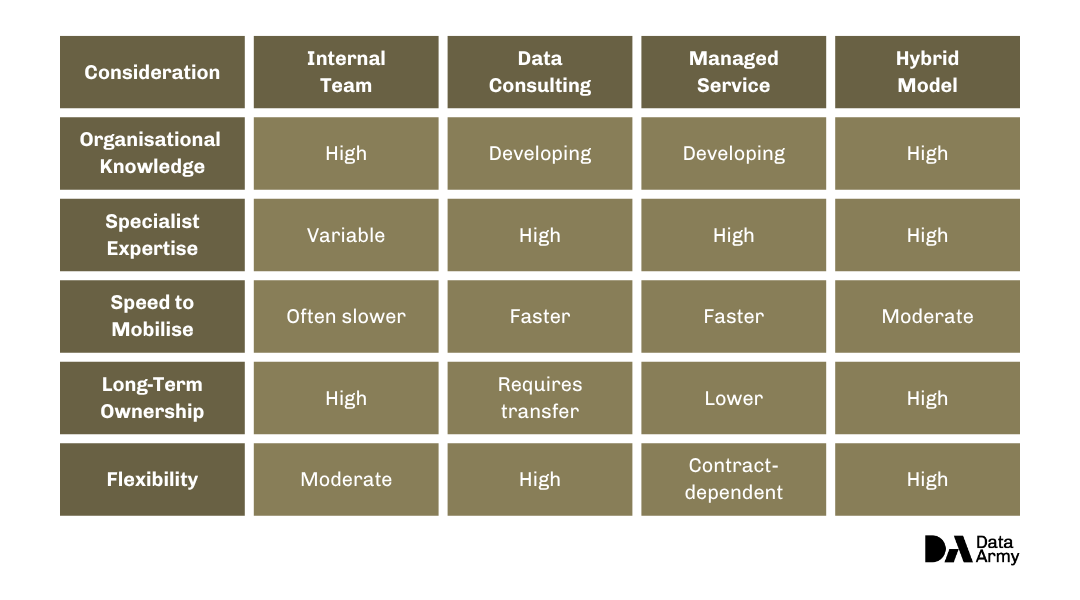
| Model | Best suited to | Principal advantage | Principal risk |
| Build internal capability | Enduring capabilities closely tied to strategy or competitive advantage | Control and retained organisational knowledge | Slow recruitment, employee turnover resulting in IP loss, and difficulty maintaining specialist breadth |
| Buy a managed service | Standardised, repeatable or operational requirements | Efficiency and predictable service | Reduced flexibility and supplier dependency |
| Partner with a data consultancy | Transformation, acceleration and specialist or temporary needs | Speed, experience and access to diverse expertise | Knowledge can remain external without deliberate transfer |
| Hybrid model | Organisations needing internal ownership and external depth | Balances continuity, speed and specialisation | Unclear boundaries can create gaps or duplicated responsibility |
5 Considerations When Deciding Whether to Build, Buy or Partner
1.
What does the organisation need to own?
The first consideration is whether the capability contributes directly to how the organisation competes, manages risk or creates value.
Start with Strategic Importance
Capabilities linked to competitive advantage, material risk or proprietary knowledge usually warrant strong internal ownership. These may include data strategy, governance decisions, business priorities and the ownership of critical data products.
Internal ownership does not mean employees must perform every task. An organisation can retain authority over architecture and governance while using external specialists to help implement the solution.
The key distinction is between decision ownership and delivery capacity. Strategic accountability should remain inside the organisation, even when execution is shared.
Before making a decision: Identify the decisions the organisation should never delegate. Ensure there is a capable internal owner for each one.
2.
Is the need permanent, temporary or intermittent?
Building internally makes sense when there is a sustained pipeline of valuable work.
If a capability will remain important for years, permanent reliance on project-based consultants may be expensive and weaken internal knowledge.
Consulting is often more appropriate for concentrated or transitional needs, including:
- developing a data strategy or target architecture
- migrating to a new platform
- recovering a stalled program
- establishing governance or engineering standards
- delivering a specialist integration
- validating a major investment decision
Some specialist skills are essential during a transformation but required only periodically afterwards. Maintaining all of them internally may not be practical. A stable internal core backed by specialist partners is usually the most efficient model.
Before making a decision: Map demand over the next two to three years. Build for sustained needs; partner for transitions, delivery peaks and specialised interventions.
3.
How quickly is the capability required?
Recruiting a multidisciplinary data team takes time. A partner mobilises in weeks; a multidisciplinary hire takes months. It also brings delivery patterns already proven elsewhere.
External support does not remove internal dependencies. Projects still need timely access, business decisions, security approvals and stakeholder participation. A partner may provide capacity and experience, but it cannot compensate for absent ownership.
A hybrid approach can address both needs: a partner accelerates the initial work while internal team members participate in delivery and progressively assume responsibility.
Before making a decision: If speed is the rationale for external support, identify the internal decisions and dependencies that could still delay time to value.
4.
What is the true cost and risk?
A data team member’s salary and consulting day rates are not directly comparable. Compare the full cost of each option, the capacity it provides and the business impact of delay or failure.
| Build internal capability (Recruit internal team) | Engage external support (Consultancy or service provider) | |
| Time to productivity | Allow for recruitment, notice periods and ramp-up. A planning estimate might be 2 to 4 months, with longer timelines for hard-to-fill roles. | Allow for availability, contracting, access and developing business context. A planning estimate might be 2 to 4 weeks to mobilise, with productivity building as context develops. |
| Full cost | Salary, superannuation, recruitment, leave, leadership, training and tooling, including periods when specialist capacity is underused. | Consulting or service fees, onboarding, internal oversight, knowledge transfer and any transition or exit costs. |
| Key person risk | Knowledge can become concentrated in one employee unless documentation, cross-training and succession arrangements are in place. | A provider may offer backup and broader expertise, but dependency can still develop around particular consultants or the supplier. Confirm continuity and handover arrangements. |
| Cost of a poor fit | Salary and management time, lost momentum and potentially another recruitment process and fee. | Fees and internal time spent, potential rework and the cost of changing providers. Clear milestones and exit terms can limit exposure. |
| Leave and capacity coverage | Paid leave and public holidays form part of employment costs. The team needs arrangements to maintain coverage. | Coverage and charges depend on the agreement. Confirm whether fees cover delivered days, reserved capacity or an ongoing service. |
| Flexibility to scale or stop | Changing capacity takes time and may involve redeployment or employment-related costs. Sustained demand can make permanent roles economical. | Capacity can be adjusted within agreed notice periods, minimum commitments and resource availability. Retainers and fixed scopes may limit flexibility. |
| Access to specialist skills | Builds lasting organisational knowledge, but specialist breadth depends on team size, recruitment and development. | Provides access to complementary expertise without recruiting every specialism. Confirm who will deliver the work and how knowledge will transfer. |
Timing examples are illustrative planning assumptions, not benchmarks or guarantees. Mobilisation and productive delivery are different milestones; compare both against the same scope and outcome.
Paying more for an experienced partner can make sense when it reduces delivery risk or brings forward an important outcome. Consulting becomes less attractive when it is used indefinitely for predictable work that an internal team could perform well.
Existing internal strengths should also shape the decision. A team may already have strong business knowledge, analytics or platform ownership but need specialist support in architecture, migration, governance or AI. The best external support fills specific gaps and leaves the internal team focused on what it does best.
Before you make a decision: Compare total cost and risk over a realistic period, including the value of earlier delivery, continuity and the capability retained internally.
5.
How will knowledge and control be retained?
Any model can create dependency. An internal platform may rely on one long-serving engineer. A consulting engagement may leave architecture, methods or operational knowledge with the supplier.
Dependency is a design choice, not an unavoidable cost of using a partner. A good partner builds continuity into the engagement from day one.
What to expect from a good data partner
- Your people own the decisions. A named internal owner stays accountable for architecture, governance and priorities. The partner advises and delivers.
- Everything lives in your environment. Code, pipelines, documentation and decision records sit in your repositories and tools, not the supplier’s.
- Maintainable, standard architecture. It uses patterns your team, or any future team, can understand, operate and extend, with no proprietary frameworks that lock you in.
- Your team works alongside ours. Internal staff take part in design and delivery, so knowledge transfers through the work itself, not through a handover document at the end.
- No single points of failure. Before the engagement ends, more than one person on your side can operate each critical system.
- An exit plan agreed upfront. The move from partner-led to internally owned is scoped at the start, with clear milestones.
This is how Data Army delivers. Our goal is to leave every client more capable than we found them, whether we step back into an advisory role or hand over completely.
Before you make a decision: Ask any prospective partner how they plan to make themselves unnecessary, and check that the answer is built into the plan.
Before you make a decision: Compare the total economics and risk over a realistic period, not the most visible line item.
Choose Capability by Capability
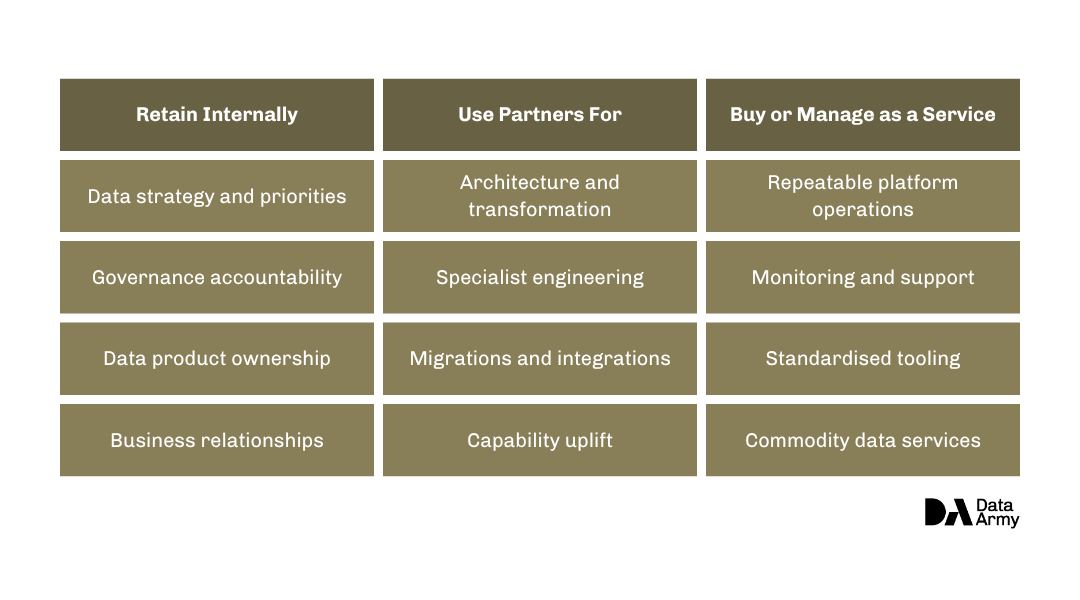
The strongest model will keep ownership of strategically important decisions inside the organisation while using external capability where it improves speed, quality or flexibility.
The aim is to put each capability where it can create the greatest long-term value.
These boundaries are not fixed. A common pattern: the partner leads delivery, then steps back into an advisory role as your team matures. Alternatively, an organisation may retain strategy and governance while continuing to use a managed service for operations.
Hybrid models work when responsibilities are explicit. Define who decides, who delivers, who operates and who improves each capability.
What Might a Hybrid Model Look Like?
For many mid-sized and enterprise organisations, a hybrid model offers a practical balance.
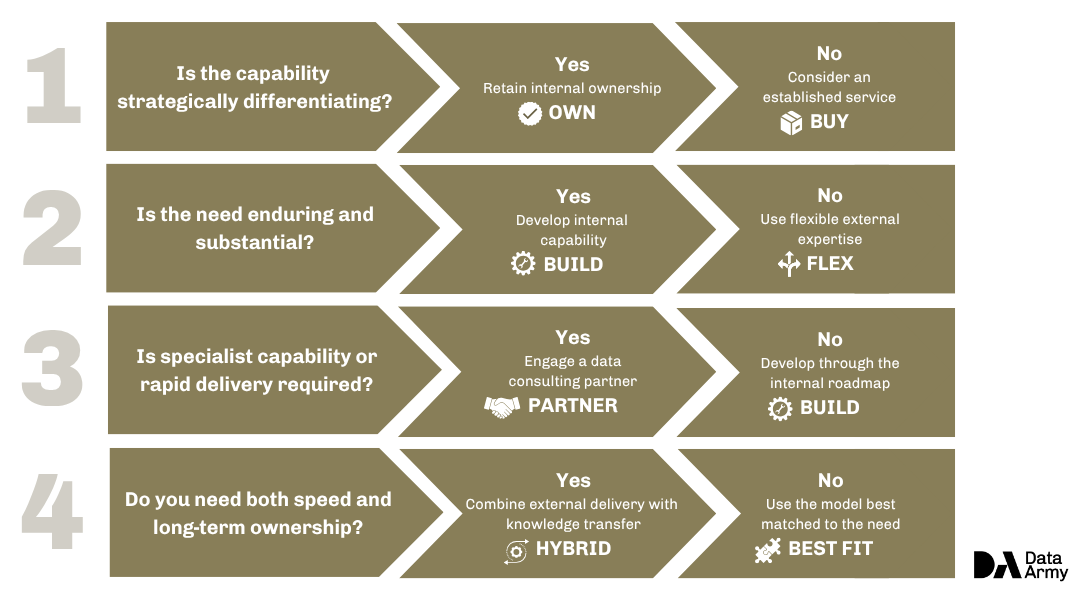
A Simplified Decision Path
Final Checklist Before Choosing a Capability Model
- Which capabilities are genuinely strategic?
- Which decisions must remain internally owned?
- Is the demand enduring, transitional or intermittent?
- How quickly must the capability become effective?
- Can the organisation attract and retain the required people?
- What is the total cost of each option over two to three years?
- What would delayed or unsuccessful delivery cost the business?
- What should the organisation be able to operate independently afterwards?
Where Advisory Services Fit
Advisory is not a fourth operating model. It can support an organisation whether it chooses to build internally, buy an established service or engage a partner for delivery.
When building internal capability, advisory brings experience that the organisation does not yet have in-house.
This may include guidance on architecture, data foundations, governance, delivery practices, operating models or moving AI from experimentation into production.
The adviser helps the internal team make sound foundational decisions while ownership and execution remain within the organisation.
When buying a service or product, advisory shapes the implementation strategy.
Selecting the right technology is only part of the decision.
The organisation still needs to determine how the service will integrate with its environment, how data will be governed, what processes must change and how value will be measured. Independent tests vendor claims and prevent the implementation from being led solely by product functionality.
Advisory also sit alongside a consulting or hybrid delivery model, providing architecture oversight, assurance or an independent view of progress and risk.
In each case, its purpose is to strengthen decisions and improve the likelihood of successful adoption, not to replace internal accountability.
Need independent data advice?
If your organisation is assessing how to structure its data capability, Data Army will give you an independent view of the options and a practical path forward.